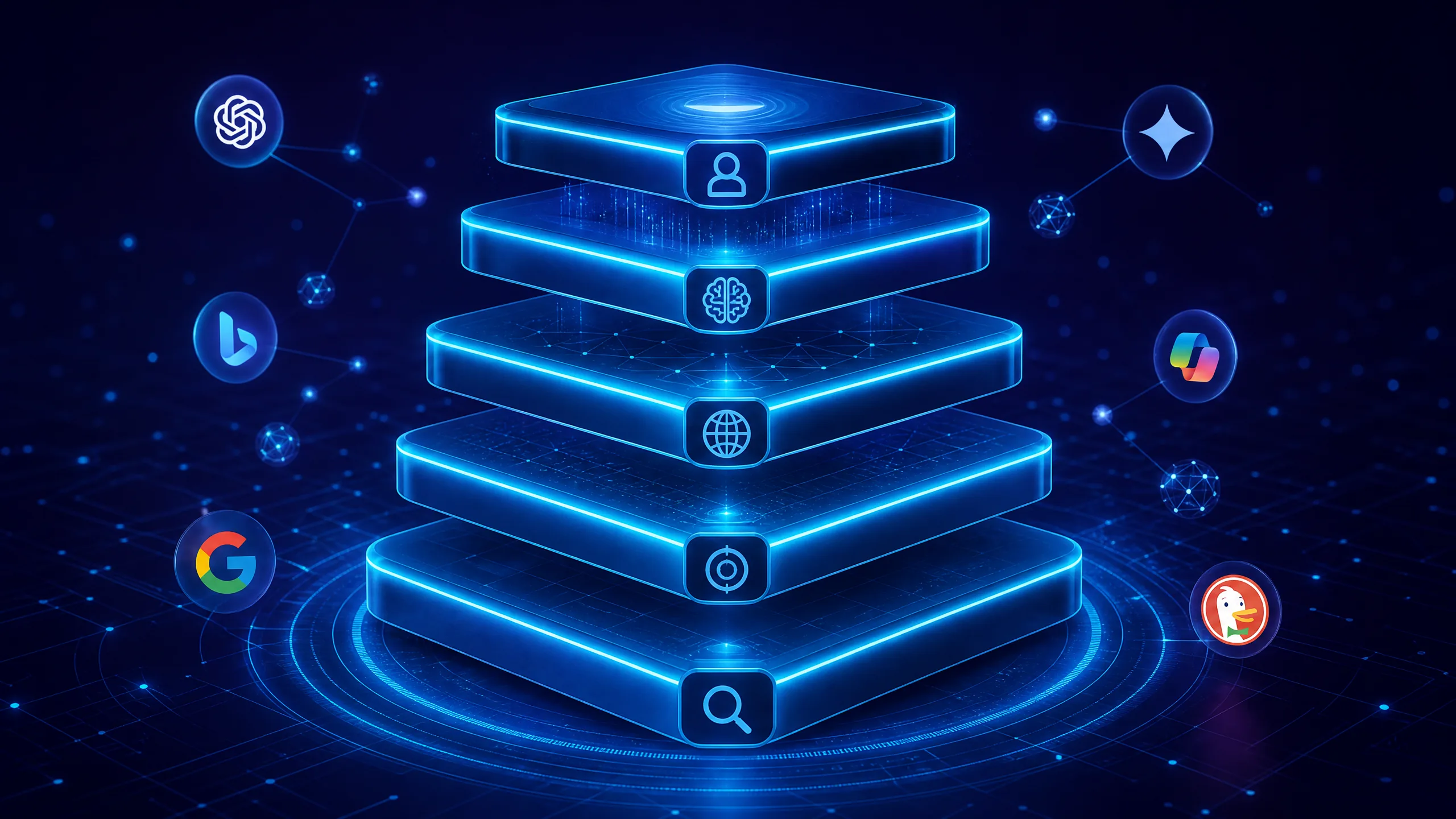

GEO (Generative Engine Optimization) and SEO (Search Engine Optimization) are complementary disciplines, not competitors. SEO ensures you rank in traditional search engines. GEO ensures you are cited in AI-generated answers. If you only do SEO in 2026, you are invisible to the fastest-growing segment of search — and if you only do GEO, you are ignoring the still-dominant traditional search market. You need both.
Search has fundamentally split into two ecosystems. Understanding how they differ — and how they work together — is now essential for any business that depends on organic visibility.
The big picture: two search ecosystems
For more than two decades, "search" meant one thing: typing keywords into Google and getting a page of links. That model still exists and still drives enormous traffic. But a second ecosystem has emerged — one where users ask questions in natural language and receive a single, synthesized answer from an AI.
Traditional search (SEO's domain): The user searches "best CRM software 2026" and gets 10 blue links plus ads. They click through, compare and decide.
AI search (GEO's domain): The user asks ChatGPT or Perplexity: "What is the best CRM for a 10-person sales team that integrates with Slack?" and gets a direct answer with 3-4 cited sources. They may never visit a search results page.
Side-by-side comparison: GEO vs SEO
| Dimension | SEO | GEO |
|---|---|---|
| Primary platforms | Google, Bing, Yahoo, DuckDuckGo | ChatGPT, Perplexity, Gemini, Copilot, Claude |
| User behavior | Keyword queries, browsing SERPs | Natural language questions, reading synthesized answers |
| Output format | Ranked list of links | Single conversational answer with inline citations |
| Core goal | Rank in top 10 for target keywords | Be cited as a source in AI-generated responses |
| Key ranking factors | Backlinks, page speed, keywords, domain authority | Content clarity, structure, schema, topical authority, E-E-A-T |
| Success metrics | Organic rankings, SERP features, CTR, organic sessions | AI brand mentions, citation rate, referral traffic from AI platforms |
| Timeline to results | 3-6 months for competitive keywords | 2-8 weeks for AI citation improvements |
| Competition level | Extremely high for most niches | Still relatively low — first-mover advantage exists |
Why SEO alone is no longer enough
SEO is not dead. Google still processes more than 8.5 billion searches per day, and organic search remains one of the highest-ROI marketing channels. But the search landscape is fragmented.
More than 65% of all Google searches now end without a click [SparkToro, 2025]. Users get their answer from a featured snippet, People Also Ask box or knowledge panel and never visit a website. When you only optimize for traditional SEO, you are optimizing for a shrinking slice of attention.
AI search platforms are growing at unprecedented rates: ChatGPT has more than 600 million weekly active users, Perplexity AI more than 100 million monthly active users. You can rank #1 on Google and still be invisible in AI search.
How GEO and SEO work together
The most effective search strategies in 2026 do not choose between GEO and SEO — they integrate both. They share foundations: high-quality content, fast websites, topical authority and trust signals. When you invest in these foundations, both your SEO and GEO performance improve.
Strong SEO can boost your GEO performance: SEO drives organic traffic and brand awareness, brand awareness increases the chance users mention your brand in public forums, and AI models train on these mentions. GEO optimization requires clearer content, which also earns more featured snippets and People Also Ask placements — improving your SEO performance.
When to prioritize SEO vs GEO
| Prioritize SEO if... | Prioritize GEO if... |
|---|---|
| Your traffic comes from high-intent commercial queries | Your audience is tech-savvy and early-adopting |
| You are in a local service business | You are in B2B SaaS, tech or professional services |
| Your buyers do extensive comparative research | Your buyers ask complex, nuanced questions |
| Your keywords have clear transactional intent | Your value proposition requires explanation and education |
Most businesses should invest in both, but the ratio depends on your audience and industry. Tools like Findori can handle the GEO-specific optimizations — schema generation, content structuring for AI, and citation monitoring — while your existing SEO tools handle traditional ranking factors.
Frequently asked questions
Can I do GEO without SEO?
Technically yes, but it is not recommended. SEO builds the foundational authority and traffic that GEO efforts depend on. GEO works best when built on a solid SEO foundation.
Does GEO require completely rewriting all my content?
No. Most websites can implement GEO by restructuring existing content — rewriting introductions to answer questions directly, adding schema markup, improving headings and building topical clusters.
How do I track GEO performance?
Start with manual checks: ask ChatGPT and Perplexity questions in your niche and see if your brand is cited. Track referral traffic from AI platforms in Google Analytics. WordPress users can use Findori to automatically monitor AI citations. For a practical breakdown of which content structures get cited most, read Getting cited more often by AI search engines: what actually works.
Key takeaways
- GEO and SEO are complementary, not competing. They optimize for different search ecosystems that now coexist.
- SEO alone leaves a growing visibility gap. AI-native search is growing fast, and SEO-only strategies miss this audience entirely.
- They share foundations — quality content, technical soundness and authority — but require different tactical execution.
- 2026 is the ideal time to start with GEO — competition is still low, and early movers will establish advantages that are hard to displace.